
Meet Uncle Cornpone
Thrown into the international spotlight as our nation's 36th (albeit reluctant) president following the November 23, 1963 assassination of John F. Kennedy, Lyndon Baines Johnson towers over his predecessors and successors - literally, as well as figuratively, at 6' 4" (the same height as Abraham Lincoln) - as undoubtedly the most colorful, folksiest-to-a-fault figure to captain this ship of state.
Biographer Robert Dallek noted in Flawed Giant: Lyndon Johnson and His Times, 1961-1973, "Outlandish comments were parts of Johnson's political calculations. Urinating in a sink, inviting people into the bathroom, showing off a scar, exposing his private parts - after a while, nothing surprises the biographer. For Johnson, they were meant to shock and confuse and leave him in control."
In April 1964, LBJ was walking his pair of pet beagles, famously named Him and Her, outside the White House, with members of the press in tow, when he stooped and shocked onlookers by casually picking Him up by the ears. Photographers snapped away, and the incident became headline news across the nation.

After gall bladder surgery in September 1965, President Johnson spontaneously bared his abdominal scar to the media. For this antic alone, history seemingly deemed LBJ a hayseed devoid of any social graces. (During his vice presidency, he was derisively referred to as "Uncle Cornpone" by the elitist Kennedy brothers.)

At one moment, Johnson could be dissing U.S. Representative and Warren Commission appointee Gerald Ford with the verbal shot, "Jerry Ford is so dumb he can't fart and chew gum at the same time," and in the next moment, he would be nonchalantly asking a tailor for an extra inch in his slacks "down where your nuts hang...back to my bunghole."
Playwright Robert Schenkkon, who wrote the Tony Award-winning drama "All the Way"(depicting Johnson's political square dance to get his presidency-defining Civil Rights Act of 1964 passed), told an interviewer, "If you asked any of the individuals who worked with Johnson over the years, they would say something like, 'He was the kindest, cruelest, most selfless, selfish son of a bitch, warmhearted, conniving, lying, decent man I ever met.' They wouldn't be lying."
 |
| Two hours after the assassination of John F. Kennedy, Lyndon B. Johnson was sworn in as president aboard Air Force One, flanked by his wife, Claudia "Lady Bird" Johnson, and JFK's widow, Jacqueline Kennedy. |
Lyndon Johnson's Great Society initiated the largest expansion of federal government programs since the New Deal under President Franklin D. Roosevelt, who was a personal and political mentor of LBJ, creating more than 200 significant pieces of legislation encompassing civil rights (the aforementioned Civil Rights Act of 1964 attacked discrimination in jobs and public accommodations), the war on poverty (including the formation of VISTA, Head Start, and the Food Stamp Act), education (the National Endowment for the Arts was created, as was the Corporation of Public Broadcasting), health (Medicare and Medicaid were created), and the environment (greater conservation efforts came from the passing of the Wilderness Act and the National Preservation Act).
Unequivocally, the sweeping scope of LBJ's Great Society eclipsed the New Deal and the New Frontier combined, resulting in what Kenneth C. Davis, author of Don't Know Much About the American Presidents, called a "veritable 'hit list'" of federal departments and liberal regulations "that many conservatives have been committed to abolishing ever since."
The Films of Lyndon Johnson
And yet, despite his spectacular breakthroughs as a champion of civil rights, President Johnson has been ignored, if not shunned, by filmmakers on TV and in theaters, until now, but we'll get back to that. Not surprisingly, there have been close to 400 portrayals - dramatic, comedic, animated - of the country's most revered commander in chief, Abraham Lincoln. Founding father George Washington comes in second with 240 portrayals, while LBJ's predecessor, John F. Kennedy,has been depicted 115 times in films, made-for-television movies, and miniseries. Lyndon Johnson has had to settle with a mere 45 screen credits, and that's a stretch.
There would be no Academy Award-winning tour de force like Daniel Day-Lewis' performance in "Lincoln," no scenery-chewing of Shakespearean proportions like Anthony Hopkins' Oscar-nominated role in "Nixon." Nor would there be a whole-world-is-watching nail-biter the likes of "Thirteen Days," dramatizing JFK's Cuban Missile Crisis when global superpowers teetered on the brink of all-out nuclear war; not even the intimate conflict of personalities between a determined President Harry S. Truman (E.G. Marshall) and an insubordinate General Douglas MacArthur (Henry Fonda) depicted in the TV film "Collision Course."

No, the first actor of note to play President Lyndon B. Johnson was comedian Jack Riley (best known as the toupeed, acerbic misanthrope, Elliott Carlin, on "The Bob Newhart Show") in an appearance on "Rowan & Martin's Laugh-In" in 1968, wondering aloud, "I have just one question. What was Spiro Agnew's name before Professor Backwards got hold of it?"
 |
| "I love the java jive and it loves me." Jack Riley on "The Bob Newhart Show." |
Pretty much dismissed as cheesy exploitation, 1977's "The Private Files of J. Edgar Hoover" was written, produced, and directed by '70s B-movie auteur Larry Cohen, best known for the "It's Alive" pictures about killer mutant infants (or is it infant mutants?) and featured a curious ensemble of aging Hollywood veterans like Broderick Crawford, Jose Ferrer, Celeste Holm, and Dan Dailey, and such cult movie thespians as Quentin Tarantino favorite Michael Parks, Rip Torn (a familiar presence as Artie, Garry Shandling's producer on "The Larry Sanders Show,"and as Zed in the "Men in Black" films), and Ronee Blakley (best known for playing country superstar Barbara Jean in Robert Altman's "Nashville."
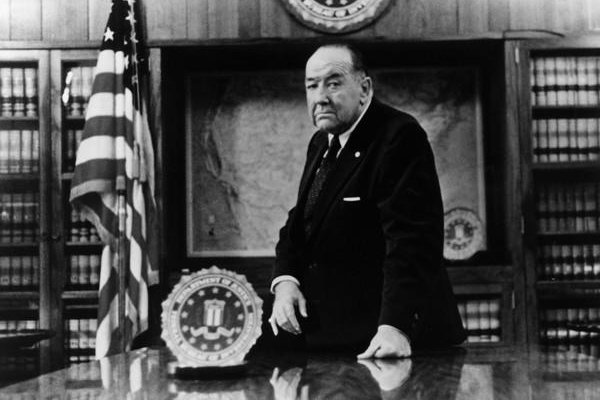 |
| Broderick Crawford, who won the Best Actor Oscar for his role as an ambitious, ruthless politician in "All the King's Men" (1949), appears to be disappointed that no such accolades would follow his title performance as J. Edgar Hoover. |
 |
| Andrew Duggan (behind James Coburn) looks - um - less than presidential in this pose from "In Like Flint," but with scenery like this, who cares? |
 |
| Couldn't find a picture of Texas-born actor Rip Torn as LBJ in the 1987 TV movie "J. Edgar Hoover," but at least this is him in a cowboy hat playing a Texas lawman in the 1987 Nick Nolte film "Extreme Prejudice." |
Lyndon Johnson was played in "King" by Warren J. Kemmerling, an actor familiar to fans of "Close Encounters of the Third Kind" as the no-nonsense major determined to evacuate all civilians from Devils Tower in Wyoming, ominously intoning, "What I need is something so scary, it'll clear 300 square miles of every living Christian soul."
 |
| Warren J. Kemmerling looks very Lyndon Johnson-like as Major "Wild Bill" Walsh in "Close Encounters of the Third Kind." |
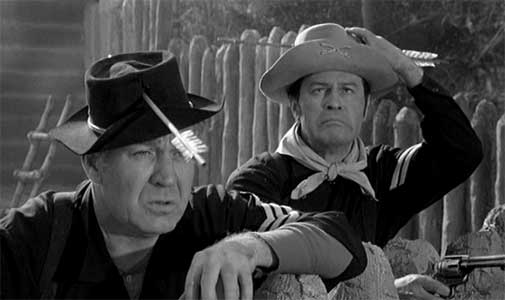
In "The Right Stuff" (1983), a saga of the seven men selected to be the first astronauts for Project Mercury, scripted (based on Tom Wolfe's best seller) and directed by Philip Kaufman, Donald Moffat had a small role as U.S. Senator/President Lyndon Johnson.
Donald Moffat (a Moviehouse favorite for his role as Garry, the Antarctic research station commander in John Carpenter's "The Thing") is frequently mistaken for fellow character actor James Cromwell (best known as Farmer Hoggett in "Babe"). Cromwell, as well, portrayed Lyndon Johnson in the 2002 TV movie "RFK," starring Linus Roache, a British actor known for his role as King Egbert of Wessex on The History Channel series "Vikings."
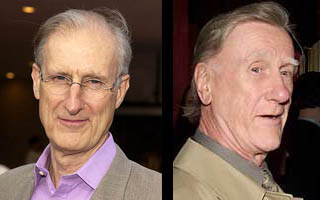 |
| Let's see, that's James Cromwell on the left and Donald Moffat on the right ...or is it Donald Moffat on the... |
Director Marvin J. Chomsky, the king of the miniseries in the 1970s into the early '80s ("Roots," "Holocaust," "Inside the Third Reich," "Peter the Great") helmed the 1985 miniseries "Robert Kennedy and His Times," based on historian and former special assistant to JFK Arthur Schlesinger Jr.'s biography of the same name. Brad Davis (best known for his breakout performance as Billy Hayes in 1978's "Midnight Express") portrayed RFK in a formidable cast that included Veronica Cartwright as Ethel Kennedy, Cliff DeYoung as JFK (in the previously mentioned "King" miniseries, DeYoung played Robert Kennedy), Ned Beatty as J. Edgar Hoover, and G.D. Spradlin as Lyndon Johnson (pictured below). Spradlin, of course, remains a Moviehouse favorite for his roles as the Tom Landry-like football coach, B.A. Strother, in "North Dallas Forty" and as the oily Nevada Senator Pat Geary in "The Godfather Part II."

Actor Laurence Luckinbill starred in the 1987 television movie "Lyndon Johnson," directed by Charles Jarrott, a British filmmaker more at home with such historical costume dramas as "Anne of the Thousand Days" and "Mary, Queen of Scots." The production later became a one-man stage show that Luckinbill took on tour in 1991 (pictured below).

Also in 1987, Richard Anderson (familiar to TV viewers as Oscar Goldman, Steve Austin's boss on the 1970s TV series "The Six Million Dollar Man," as pictured below, with Lee Majors) was cast as LBJ in the four-hour miniseries "Hoover vs. the Kennedys: The Second Civil War," dramatizing the political contentions between FBI Director J. Edgar Hoover and President John F. Kennedy and U.S. Attorney General Robert Kennedy, from the 1960 Democratic National Convention to the assassination of RFK in 1968.

The 2002 HBO film "Path to War" concerned the Vietnam War as dealt directly with by President Johnson and his cabinet. Michael Gambon, an Irish-born actor who took over the role of Professor Dumbledore in the "Harry Potter"pictures following the death of Richard Harris, garnered an Emmy Award nomination for his turn as LBJ (pictured below).

"Path to War" turned out be the final movie directed by John Frankenheimer, a one-time Hollywood wunderkind best known for "The Manchurian Candidate," "Seven Days in May," and, among others, "Grand Prix." The impressive array of supporting players featured Donald Sutherland as the president's Intelligence Advisory Board Chairman, Clark Clifford, Alec Baldwin in an Emmy-nominated performance as U.S. Secretary of Defense Robert McNamara, and Gary Sinise as Alabama Governor George Wallace. A few years earlier, Sinise won an Emmy Award for his portrayal of Wallace in the made-for-television movie "George Wallace," also directed by John Frankenheimer.
Since the publication of Killing Lincoln in 2011, Fox News political commentator Bill O'Reilly has annually authored, with co-writer Martin Dugard, a Killing... novel, namely Killing Kennedy, Killing Jesus, Killing Patton, and Killing Reagan. Killing Kennedy was adapted for a movie for National Geographic Channel in 2013, featuring Rob Lowe as JFK and directed by Nelson McCormick, who was responsible for the 2000s remakes of the '80s cult horror flicks "Prom Night" and "The Stepfather." Lyndon Johnson was played by Francis Guinan, an actor probably best known as scientist Edgar Teller in the short-lived 1991 series "Eerie, Indiana."
 |
| Rob Lowe (as JFK) and Francis Guinan (as LBJ) share an illuminating scene in "Killing Kennedy." |

Twice Oscar-nominated British actor Tom Wilkinson, who earned a Best Supporting Actor Emmy Award for his role as Benjamin Franklin in the 2008 HBO miniseries "John Adams," portrayed Lyndon Johnson (pictured below, with David Oyelowo as Martin Luther King Jr.), in "Selma" (2014), co-produced by Oprah Winfrey, who appears onscreen as Annie Lee Cooper, the civil rights activist arrested for punching Selma Sheriff Jim Clark.

Historians might argue that the presidency of LBJ was the peak of modern liberalism in the U.S., Lyndon Johnson himself is ranked favorably by historians, political scientists, and popular opinion because of his domestic policy. Johnson's success in passing major laws affecting civil rights and the elimination of poverty was aided greatly by the Democratic landslide in the 1964 election that brought in a number of new liberals to Congress and on the president's unparalleled powers of persuasion.

Johnson, a Texas-bred wheeler and dealer during his tenures in the House of Representatives and the Senate, skillfully cajoled, badgered, flattered, coerced, and compromised to get what he wanted as a power broker - occasionally under dubiously legal circumstances, such as the hotly disputed vote that took him to the U.S. Senate in 1949 via fraudulent election returns, earning him the sarcastic nickname "Landslide Lyndon," which he happily adopted - making him one of the most adept legislative leaders on the Hill.

In Don't Know Much About the American Presidents, author Kenneth C. Davis noted, "Tall and physically imposing, he was ambitious, fiercely competitive, at times gentle and solicitous, sometimes ruthless." Or, exactly as Randy Quaid portrayed him in the 1987 made-for-television film "LBJ: The Early Years," presenting one of the most inspired portraits of the political firebrand during his pre-presidential years from 1934 to 1963.
 |
| Patti Lupone, best known for her acclaimed musical stage roles (including a Tony Award-winning turn in "Evita"), played Lady Bird Johnson, with the ubiquitous James F. Kelly as Robert Kennedy and Charles Frank as JFK. |

"I don't know why this call stuff Hamburger Helper, it does just fine by itself."
Born in Houston, Texas, Randy Quaid was "discovered" in 1971 by director Peter Bogdanovich at the University of Houston and was cast as Cybill Shepherd's escort at the skinny-dipping pool party in "The Last Picture Show."
 |
| Randy Quaid discovers meeting new friends is always awkward in "The Last Picture Show," with Cybill Shepherd. |
 |
| Vincent Canby of The New York Times commented on the "superbly funny" and "uproariously intelligent" performances in "The Last Detail," "so effectively surrounded by profound bleakness that it seems to be a new kind of anti-comedy." |
 |
| "Fuck help, fuck fair! Fuck injustice! Don't you ever just wanna fuckin' whomp and stomp on someone, bite off their ear, just to do it? I mean just to do it, get it out of your system?" Jack Nicholson, who once joked that he wanted to win more Academy Awards than Walt Disney, was disappointed in his failure to turn the Oscar nomination for his role as "Badass" Buddusky into a win. "I did it in that movie," he said. "That was my best role." |

Other notable screen roles for the actor came in "Midnight Express," "Quick Change," "Brokeback Mountain," and "The Ice Storm."
 |
| The hills are alive with the sound of - wait, that sure isn't music I'm hearing... Randy Quaid as Wyoming sheepman Joe Aguirre in "Brokeback Mountain." |

On the other side of the mirror, Randy Quaid's most enduring film role has to be Cousin Eddie, the blissfully ignorant, Hamburger Helper-grillin', shitter-emptyin' creepy dad in "National Lampoon's Vacation," "National Lampoon's Christmas Vacation," "Vegas Vacation," with Chevy Chase and Beverly D'Angelo, and in his own, direct-to-video comedy, "Christmas Vacation 2: Cousin Eddie's Island Adventure."

 |
| Who can forget Jane Krakowski (a couple decades before her role as Jenna Maloney on "30 Rock") as Cousin Eddie's 15-year-old daughter, Vicki, who confesses. "I'm going steady and I French kiss...Daddy says I'm the best at it." |

As a full-tilt bull goose loony, Randy Quaid pulled out all the stops in his role as rabid attorney Peter Blunt in the otherwise dreadful 1988 sequel "Caddyshack II" (pictured below).
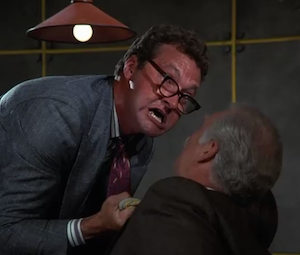 |
| "Well, you certainly made it very clear how your legal system works...Now I'd like to explain a little about the Peter Blunt system...I don't go in for lawsuits and motions or any of the legal stuff. No, you see, what happens is I find out where you live and then I come to your house, see, and I beat down your door with a fucking baseball bat. And then I make a bonfire with the Chippendale, maybe roast that golden retriever - woof! woof! woof! - then eat it. And then I'm comin' upstairs, junior, and I'm gonna grab you by your Brooks Brothers p.j.'s and then I'm gonna take your brand new BMW and cram it up your tight ass! Do we have an understanding?" |
 |
| In cornball dialogue right out of a gung-ho propaganda programmer from the 1940s, the self-sacrificing crop duster nobly radios the boys at HQ, "Do me a favor. Tell my children...(choke!)...I love them very much. All right, you alien assholes, in the words of my generation, up YOURS!" |

And then things started getting interesting, when Randy's life started imitating his art. In September
2009, Quaid and his wife, Evi, were arrested in Texas on charges of defrauding an innkeeper, burglary, and conspiracy, stemming from an occasion when the Quaids vacated a Santa Barbara, California hotel with a balance due of $10,000. After repeatedly missing court dates and playing legal hopscotch with arrest warrants, Randy managed to have the case against him dismissed for lack of evidence, while Evi copped a no-contest plea to a misdemeanor and was granted a three-year probation, with 240 hours of community service.

One year later, again in Santa Barbara, Randy and Evi Quaid faced burglary charges for squatting in a guest house without the owner's permission. Booked for a felony and a couple of misdemeanors, the couple was accused of causing more than $5000 in damages to the guest house. They posted bail and were released, only to have a bench warrant for their arrest issued when they failed to appear for a hearing.
In October 2010, the Quaids were arrested in Vancouver, in the Canadian province of British Colombia, where they hoped to be given sanctuary under the Canadian Immigration and Refugee Protection Act. They sought refugee status on the grounds that they feared for their lives in the U.S., where they claimed several actors who died under mysterious circumstances had actually been assassinated by a secret cabal called the "Hollywood Star Whackers," whose victims already included David Carradine (Randy's "The Long Riders" costar), Heath Ledger (Randy's "Brokeback Mountain" costar), and Philip Seymour Hoffman. The Quaids lived as fugitives in Canada after it was discovered that Evi was a "prima facie" Canadian citizen, facing imminent arrest should they return to the U.S.

In February 2011, Randy Quaid, with full beard and manic demeanor, posted a viral video on YouTube, blaming media mogul Rupert Murdoch for his trials and tribulations, while a bored Evi lounged in a bikini and boots in the background. The rant climaxed when Evi dropped her dainty bottoms and Randy got behind her while she wore a paper Rupert Murdoch mask.

Also in 2011, Evi Quaid produced and directed a low-budget docudrama titled "Star Whackers," featuring her husband, dwelling on their perception of the alleged criminal conspiracy. Dismissed as "drugged-out dreck" by the critic for a Vancouver newspaper, the movie was shown once and has not since been commercially available.
Backed by a loud and not very good honky tonk band dubbed the Fugitives, Randy Quaid recorded a music video for his song, "Star Whackers," in 2011, containing such rambling drivel as: "Put your name and face on all the maps / Lots of pictures of your body bag / When you're good and dead and have no say / They'll sell your vital organs on eBay."
In a 2011 interview in People magazine, Randy Quaid's younger brother, Dennis, said, "I love my brother. That's all I can say. I love my brother and I miss my brother. That's all I'm going to say."
 |
| Dennis Quaid and Randy Quaid get into character as Ed Miller and Clell Miller in "The Long Riders." |
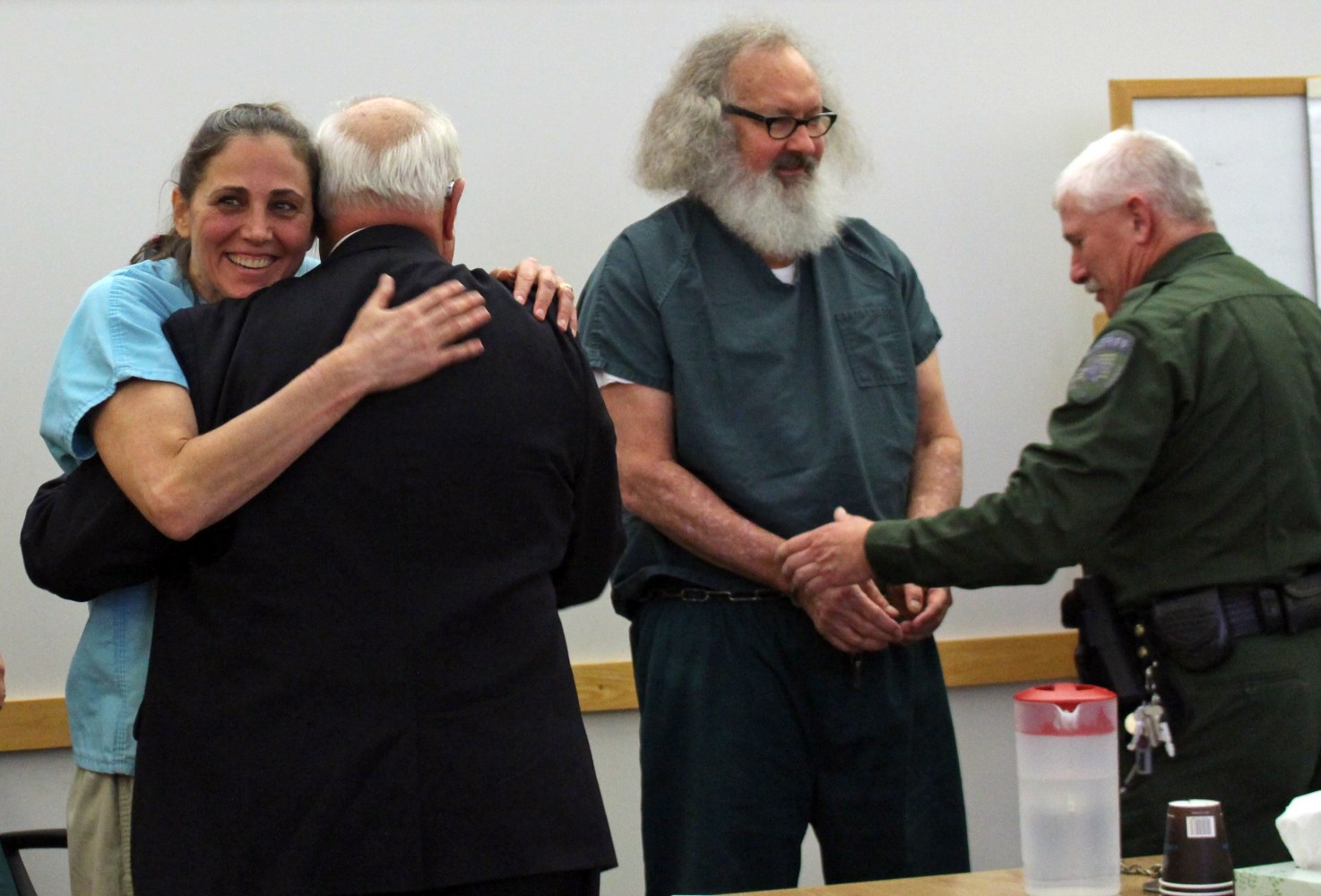 |
| After a Vermont judge dismissed fugitive-from-justice charges against the Quaids, Randy admitted, "It's a very big relief to have been vindicated to a great extent." |

"Quaid's LBJ was complex," Rosenberg commented. "But he was lewd and hot-sauced, a twanging tumbleweed with credibility, mingling with good ol' boys and county sheriffs while barbecuing and back-slapping his way up the Texas political ladder. In the role of his career, Quaid was the longest of longhorns, capturing LBJ's appetites, his driving energy, his overpowering personality and his tyranny."
Mr. Cranston Goes to Washington
Nearly three decades after "LBJ: The Early Years," HBO aired what may be the definitive depiction of President Lyndon Johnson, "All the Way," starring Bryan Cranston, a three-time Emmy Award nominee as supporting actor in the sitcom "Malcolm in the Middle," winner of four best actor Emmy Awards for "Breaking Bad," and an Oscar nominee for his role as blacklisted Hollywood screenwriter Dalton Trumbo in "Trumbo."
Premiering in 2012, the play "All the Way" (the title comes from Johnson's 1964 campaign slogan, "All the Way with LBJ"), concerned the behind-the-scenes efforts of the president to pass the Civil Rights Act, which would forbid discrimination based on race, sex, national origin, or religion and end unequal application of voter registration requirements and racial segregation. The play and original star Bryan Cranston (pictured onstage below) won Tony Awards.

For the HBO film, which premiered May 24, 2016, the scope of the drama was broadened to encompass the year between JFK's assassination and LBJ's election in November 1964. For the theater, Bryan Cranston applied his own makeup. For the movie, he endured two-and-a-half hours in the makeup chair daily, having prosthetics glued onto his ears while adding lifts to his shoes. He wisecracked, "Fortunately, my own natural physical makeup is what every man searches for: beady eyes and thin lips."
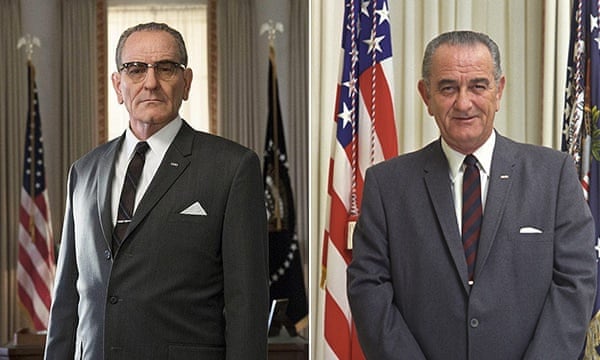
Director Jay Roach, who directed Cranston to his Academy Award nomination for "Trumbo," said that co-executive producer Steven Spielberg told him "there was an opportunity with the camera to be in (the) most desperate places with Johnson where was no hope, those moments of a personal meltdown. Steven said, 'Commit to those quiet moments. Just make sure they are cinematic.'"
Deeming Cranston's role in the film "a tour de force performance" that "also has the benefit of being accurate," Neal Justin, TV critic for the Minneapolis Star Tribune, remarked, "That Bryan Cranston so brilliantly maintains the 36th president's bluster...without ever turning him into a cartoon character is further proof that he's among our craftiest, most daring actors."

Firmly convinced that Cranston "belongs on the shortlist of America's greatest living actors," Neal Justin noted, "The 'Breaking Bad' veteran covers the gamut: bullying senators from his toilet seat, fussing over Southern Dixiecrats, pouting about his political future like a child who didn't get a lollipop at the end of an Oval Office tour...Cranston's performance is so riveting it makes other key players look like extras."
In September 2015, filming began for "LBJ." First, the good news: the big-screen biopic is not directed by Oliver Stone. Whew! The director is Rob Reiner, who hasn't made a box office hit since 2007's "The Bucket List," starring Jack Nicholson and Morgan Freeman.

Woody Harrelson, who received a Best Actor Oscar nomination for his role as the paraplegic nudie magazine publisher in "The People vs. Larry Flynt" (1996), adds President Lyndon Johnson (pictured above) to his retinue of historical portrayals (including walking-dead hunter Tallahassee in "Zombieland"), alongside Jennifer Jason Leigh as Lady Bird Johnson and Jeffrey Donovan (who played RFK in Clint Eastwood's 2011 biopic "J. Edgar," starring Leonardo DiCaprio) as JFK. But hold onto your fly-fishing hats, folks, because that twerpy towhead from "On Golden Pond," Doug McKeon (pictured below), shows up as LBJ's vice president, Minnesota's own "Happy Warrior," Hubert H. Humphrey.

Interestingly, Woody Harrelson's estranged father, Charles Harrelson, was a Texas hitman-for-hire who notoriously claimed to have killed President John F. Kennedy but later admitted he made up the story. Sentenced to life in prison for murdering a Texas judge, Charles Harrelson died of a heart attack behind bars in March 2007.
"During the '60s I was a hippy," "LBJ" director Rob Reiner admitted, "and Lyndon Johnson was my president. At the time, LBJ was the target of most of my generation's anti-Vietnam War anger. But as time has passed, and my understanding of political realities has grown, I've come to see LBJ in a very different light. He was a complex man, a combination of brilliant political instinct, raw strength, ambition and deep insecurities. The strength and power of persuasion that he showed to his colleagues existed alongside a soft, almost childlike quality that perhaps only Lady Bird got to see. His life's path was nothing short of Shakespearean. From the poor hill country of West Texas to the corridors of power in Washington, he used his brilliant political acumen to pass the most groundbreaking civil rights legislation of the 20th century. And had it not been for the Vietnam War, I believe he would have gone down as one of America's greatest presidents."
The Decline and Fall of Landslide Lyndon
Without a doubt, Lyndon Johnson endured a tortuous presidency. He seemingly bore a mantle of sadness he was never able to shirk. The televised speeches of this visibly anguished individual were frequently predicated with the oft-mocked, "My fellow Americans, it is with a heavy heart that I speak to you tonight." As a matter of fact, in his first speech to Congress in the U.S. House of Representatives on April 16, 1945, he said, "Mr. Speaker, Mr. President, Members of Congress: It is with a heavy heart that I stand before you...Only yesterday, we laid to rest the mortal remains of our beloved president, Franklin Delano Roosevelt."
 |
| President Franklin D. Roosevelt shakes the hand of newly elected U.S. Congressman Lyndon B. Johnson in this 1937 photograph. |

The day after John F. Kennedy's assassination, Lyndon Johnson, who had fretted over being dropped by the Kennedys from the 1964 campaign, told an aide, "I am a Roosevelt New Dealer...Kennedy was a little too conservative to suit my taste." When Johnson declared his unconditional war on poverty, he embraced a program that was rooted in JFK's New Frontier but vastly transcended it. Assuredly, once LBJ assumed the White House, he was driven by his own, unwavering sense of social justice.
Raised as a hardscrabble Depression-era Texas Democrat, Johnson had become one of President Franklin Roosevelt's most loyal New Dealers. Finally, however, LBJ's epic vision and noble quest for the Great Society were undone by his misguided commitment to the Vietnam War.
When LBJ inherited the "police action" (it was never a declared war) in November 1963, America was already more than ten years into its commitment overseas. The conflict in Southeast Asia would last another twelve years, cost $220 billion, and take more than 50,000 American lives.
And now, here's your Reader's Digest abridged history of the Vietnam quagmire. Early in 1953, the French asked Republican President Dwight D. Eisenhower for assistance in French Indochina opposing Communist forces, which were being supplied by China.
After French forces withdrew from Indochina in 1954, Vietnam was partitioned as northern and southern zones. Eisenhower believed, "You have a row of dominoes set up, you knock over the first one, and what will happen to the last one is the certainty it will go over very quickly." Before you could say "Domino Theory," the U.S. committed money, materials, and advice. After the election of 1960, Eisenhower warned Kennedy that the Communist threat in Southeast Asia would require prioritization. By the end of 1963, 15,000 military advisers were in place to support the anti-Communist Saigon government.
Following President Kennedy's death, Lyndon Johnson, who wholeheartedly subscribed to the Domino Theory, committed America to contain all Communist expansion. The president and his cabinet purposely dug for provocations to escalate the situation to push it it to a hasty conclusion. By the end of 1964, the U.S. presence in Vietnam had grown to more than 20,000, and by the end of 1965, the conflict became an American war. More than 148,000 combat and support troops were deployed to South Vietnam, and by 1967, that number surpassed 400,000.
In a February 1966 speech, LBJ declared, "Our purpose in Vietnam is to prevent the success of aggression. It is not conquest, it is not empire, it is not foreign bases, it is not domination. It is, simply put, just to prevent the forceful conquest of South Vietnam by North Vietnam."

According to Johnson biographer Robert Dallek, "The war brought out Johnson's propensities for overbearing, high-handed control and imperiousness, which is often displayed by insecure characters threatened by any challenge to their power and stature. Though the public did not know the full story of LBJ's erratic behavior during his presidency, it did become increasingly aware of his manipulativeness and morbid determination to sustain a questionable war in Vietnam."
In April 1967, more than 300,000 protestors surrounded the Pentagon. In D.C., the war hung heavy like a cursed albatross around Lyndon Johnson's neck as he couldn't help but overhear the chants of "Hey! Hey! LBJ! How many kids did you kill today?" By the fall of 1967, only 35 percent of Americans supported the war. A year later, after announcing a complete halt to the aerial and naval bombardment of North Vietnam, LBJ, again with a heavy heart, decided not to run for reelection in 1968.
 |
| The successor, Richard Nixon, confers with the incumbent, Lyndon Johnson. |
 |
| At least in the last few years of his life, Lyndon enjoyed letting his hair grow out. |

Ironically, these days, Vietnam is at loggerheads with former ally China. which "claims" much of the seas off Vietnam's 2000-mile coastline. President Obama, in a warmly received visit to Hanoi in late May 2016, proclaimed, "No other nation can impose its will on you...big nations should not bully smaller ones," drawing loud applause from the crowd.
Insult to Injury

In reviewing the aforementioned HBO movie "Path to War" (pictured above, with Michael Gambon and Donald Sutherland), the Los Angeles Times TV critic Howard Rosenberg called the production "a powerful expression of mourning - at once for LBJ and his Great Society that could have been greater and for a nation in prolonged agony because of miscalculations by its president and his closest advisers." Prolonging an agony for President Johnson personally, perhaps, was the additional burden of repeatedly being mentioned in conspiracy theories regarding the death of JFK, undue allegations of which LBJ seldom stooped to address but which persist to this day.
Most theories surrounding the assassination imagine a criminal cabal involving parties as varied as the CIA, the Mafia, Vice President Johnson, Fidel Castro, and the KGB, or some combination thereof. One Madeleine Duncan Brown, who claimed to be a longtime mistress of LBJ, insisting a son was born from that relationship, alleged that the vice president had foreknowledge of the plot to kill Kennedy but said nothing because of his intense dislike of the Kennedys and his equally intense desire to be president. According to Brown, the night before the assassination, at a party attended by former Vice President Richard Nixon and FBI Director J. Edgar Hoover, Johnson whispered to her, "After tomorrow, those Kennedys will never embarrass me again. That's no threat. That's a promise." Research proved that LBJ could not have been at the alleged party, and Brown, who died in 2002, has been summarily dismissed as a crackpot.
Speaking of crackpots, filmmaker Oliver Stone's controversial 1991 film "JFK," featuring Kevin Costner as New Orleans district attorney Jim Garrison in an all-star cast, propagated several of the conspiracy theories, including Stone's notion of LBJ as an accessory after-the-fact. "LBJ was as corrupt a man as I've seen in my lifetime," Stone (pictured below, with Kevin Costner) maintained. "Up there with Nixon if not worse. He led the country to war. Destroyed the ethic of the country, destroyed the economics of the country. And still there are people who defend him because he took a civil rights position that Kennedy started and rammed it through. That's like saying Mussolini made the trains run on time. Or Hitler had great architecture."
 |
| Oliver Stone: "I'm not trying to be a historian and a dramatist; I'm a dramatist, a dramatic historian, or one who does a dramatic interpretation of history." In other words, he makes stuff up. |
Bryan Cranston, in researching the role of LBJ for "All the Way," holed himself up in Johnson's presidential library for two evenings, hoping to find the key to unlock the character. He discovered it. "There in the corner, right past the assassination display," Cranston related in an interview, "was something I missed the first time. There wasn't a lot of light on it. It was a letter from Jackie (Kennedy) to LBJ dated four days after the assassination. It said, 'Dear Mr. Johnson, I want to thank you for writing those lovely letters to my two children about their father about how much you loved and respected him. They don't know it now, but they will appreciate it in the future.' So within days of taking on the most pressure-packed job in the world, this man sat down and wrote to two children when he had all these things that he needed to pay attention to. That spoke to me."
A Parting Shot
Popular folklore has it that the flags of six different governing powers have flown over Texas - Spain, France, Mexico, the Republic of Texas, the United States of America, and the Confederate States of America - but as the Moviehouse draws the curtain on this singular Texican, we were curious about other American presidents who could rightfully claim to be from the Lone Star State...

Well, hate to geld your crowbait, pardner, but both George H.W. Bush and George W. Bush were East Coast-born and -schooled.
Happy trails!


 Posts
Posts


1 comment:
Looking forward to seeing "All the Way" one of these days. Not sure how it will happen, as HBO is kinda stingy with their content, but I'd like to see it. Cranston looks great in his Lyndon Johnson makeup! As for the upcoming "LBJ" with Woody Harrelson -- I guess I'll wait and see what the critics say. Plus, Woody doesn't look very good in his Lyndon makeup. Did enjoy him in "Zombieland."
Randy Quaid. A loveable lout. A pretty great actor. A lot of good roles. Good luck to the guy.
Post a Comment